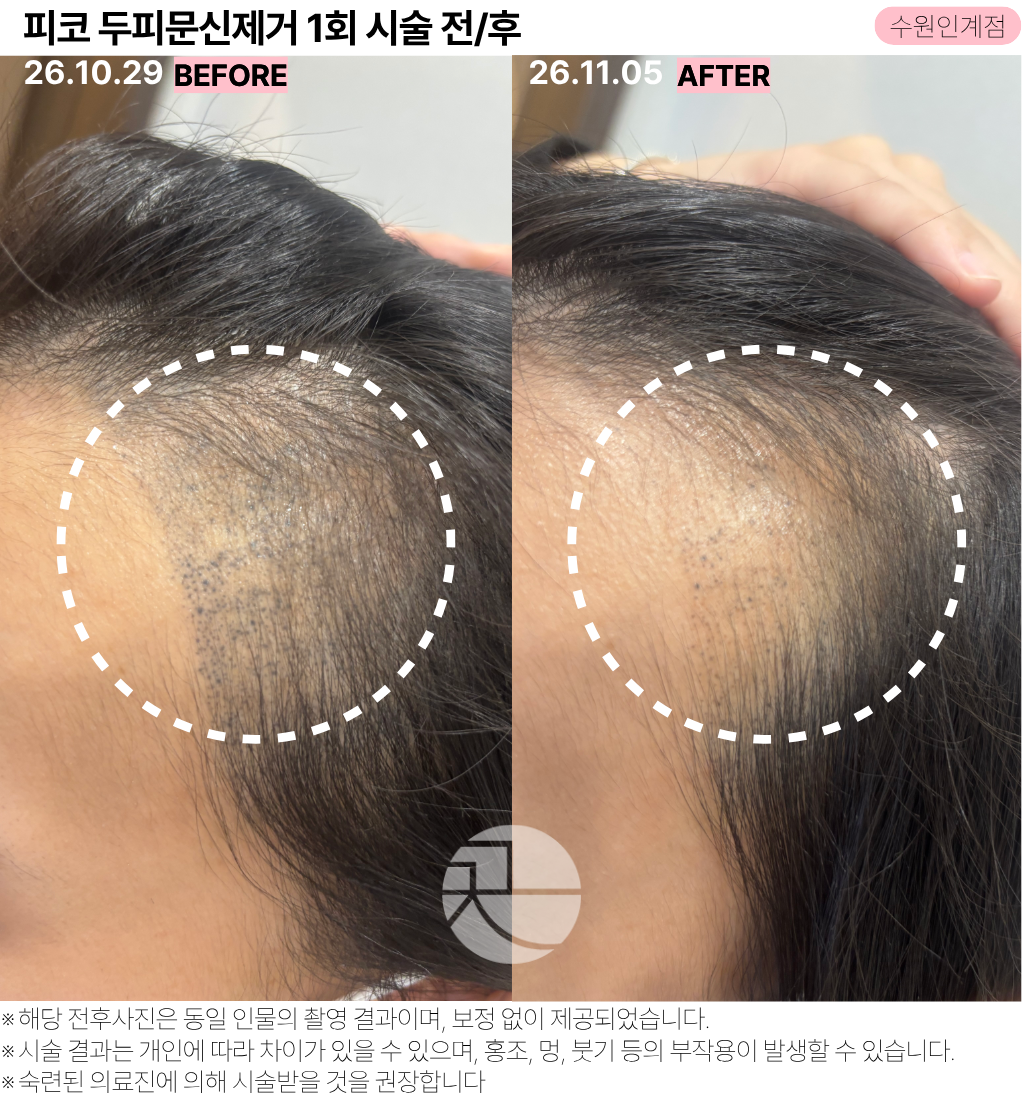
This case involves visible blue-black pigment dots along the temporal hairline following scalp micropigmentation (SMP).
Laser treatment aimed to reduce the visibility of the implanted pigment and soften its contrast with the surrounding scalp.
1) Clinical features of visible scalp micropigmentation
Scalp micropigmentation places small pigment dots within the skin to simulate the appearance of hair.
When these dots contrast strongly with the surrounding skin, they may remain individually noticeable between the hairs.
Their visibility depends on pigment intensity and distribution, particularly along exposed areas of the hairline.
2) Pigment distribution before treatment
The pretreatment photograph from the Suwon–Ingye branch in Ingye-dong, Suwon, Gyeonggi-do, South Korea, shows blue-black pigment dots along the temporal hairline.
Individual dots are clearly visible between the hairs, with clusters of darker pigment toward the lower portion of the hairline.
The contrast between these dots and the adjacent skin makes the tattooed area visibly distinct.
3) Treatment rationale and mechanism of picosecond laser removal
Picosecond laser treatment delivers energy in extremely short pulses to break implanted tattoo pigment into smaller particles.
The treatment targets the pigment responsible for the visible dark dots.
The fragmented particles are subsequently processed and cleared by the body, allowing the pigment to fade over time.
Assessment therefore considers both the immediate skin response and the pigment that remains during recovery.
4) Findings after one treatment session
Comparison of the before-and-after photographs shows that the pigment dots along the temporal hairline appear lighter overall after one session.
The previously prominent dark dots show less contrast with the surrounding skin, making the scalp tattoo less conspicuous.
Some pigment dots remain visible, and the photographs document the response after one treatment session.
The degree of fading and the number of sessions required vary according to pigment characteristics and individual skin condition.
Potential adverse effects include redness, swelling, hyperpigmentation, and hypopigmentation.
5) Treatment details
Procedure: Picosecond laser removal of scalp micropigmentation
Treatment area: Scalp